Piemonte Beyond Barolo: The Wines Italians Actually Put on the Table

There is a version of Piemonte that exists in wine books. It is a landscape of famous hillsides, celebrated vintages and bottles of Barolo waiting patiently in cellars. Nebbiolo is spoken about with reverence. Producers become cult names. Vineyards are discussed almost metre by metre.
All of this is deserved. But there is another Piemonte: the Piemonte of the dinner table.
A plate of tajarin arrives. Someone opens a bottle. There are slices of salame, perhaps a bowl of agnolotti, a piece of cheese that will remain on the table long after the plates have been cleared. And very often, the wine being poured is not Barolo.
It might be Barbera. It might be Dolcetto. It could be Freisa, Grignolino or a young Nebbiolo that has never been asked to spend twenty years in a cellar.
These wines tell us something important about Piemonte. To understand a wine region properly, it helps to look beyond the bottles people admire and towards the bottles they actually drink.
Barolo is only part of the story

Barolo may be Piemonte’s most famous destination, but it is only one part of the region’s wine story.
Barolo occupies an extraordinary position in Italian wine. Nebbiolo grown among the hills of the Langhe can produce wines of remarkable perfume, structure and longevity. Great Barolo deserves the attention it receives.
But prestige has a habit of distorting our view of a region. From Australia, it is easy to imagine Piemonte almost entirely through its most famous wines. Travel through the region—or simply begin looking more closely at what its producers make—and the picture becomes considerably broader.
Alongside their Barolo and Barbaresco, many estates produce wines intended for a different kind of occasion. Not lesser occasions, simply more frequent ones. Tuesday dinner rather than a milestone birthday. Pasta rather than ceremony. A bottle opened because friends have arrived, not because the vintage has finally reached its drinking window.
This is where some of Piemonte’s most charming wines begin to make sense.
Barbera: perhaps the ultimate table red
We have written before about our affection for Barbera, and for good reason. Few red varieties understand the dinner table quite so instinctively.
Barbera combines generous fruit with naturally bright acidity and relatively gentle tannin. That makes it exceptionally useful beside food: rich enough for ragù, sausages or braised meat, yet energetic enough to keep the meal feeling alive. Where Nebbiolo can ask for attention, Barbera often gives it to the food.
A good Barbera does not need to dominate dinner to improve it. Black cherry, plum, herbs, spice, sometimes a little oak and considerable depth. But underneath everything is freshness. It is the sort of wine that makes another forkful seem like a good idea, and then another glass.
A beautiful example is the 2023 Fontanabianca Barbera d'Alba Superiore, from Neive in the Langhe: generous and polished, but still driven by the lively acidity that makes Barbera so useful at the table.
For a different expression, the 2024 Elio Altare Barbera d'Alba brings darker fruit, violet, spice and the precision that has long defined Altare's wines. And from Monferrato, the 2022 Boggero ‘Fiore di Bosco’ Barbera d'Asti Superiore offers a fuller, richer interpretation while retaining Barbera's natural freshness.
Dolcetto: the wine whose name causes confusion
Dolcetto is one of Piemonte’s most misunderstood grapes, partly because of its name. Despite dolce meaning sweet in Italian, Dolcetto is generally a dry red wine.
Its appeal is immediate: dark fruit, plum, violet, sometimes a faint almond-like bitterness, moderate acidity and enough tannin to give the wine shape without demanding years of patience. Where Barbera tends to be driven by freshness, Dolcetto can feel softer, darker and more grounded.
This makes it particularly comfortable around simple food: salumi, agnolotti, roast chicken, polenta, a plate of cheese and whatever remains from lunch.
The 2024 Elio Altare Dolcetto d'Alba captures this beautifully: fresh, violet-scented and immediately drinkable, with precisely the sort of easy relationship with food that has kept Dolcetto on Piedmontese tables for generations.
Dolcetto is rarely the bottle around which an evening is organised. That may be precisely its charm. It belongs to the category of wine Italians understand very well: a good bottle does not always need an occasion. Sometimes the bottle is part of making the occasion.
Grignolino: pale, fragrant and wonderfully contrary
Then there is Grignolino. At first glance, it can seem almost contradictory. The colour is often relatively pale, while the perfume can suggest red berries, flowers, herbs and spice. Then comes the structure.
There is acidity. There is tannin. There can be a gently bitter, savoury edge that makes the wine feel far more serious at the table than its delicate appearance initially suggests.
Grignolino belongs particularly to Monferrato and remains far less familiar outside Piemonte than Barbera or Nebbiolo. That is a shame, because this is exactly the sort of wine that explains why Italian wine can be difficult to understand when separated from food.
Give Grignolino a plate of salumi, roast rabbit, vitello tonnato or something fried and suddenly its edges have a purpose. The wine becomes less about fruit and more about appetite. That is often where the pleasure lies.
Freisa: Piemonte's quietly fascinating red
Freisa is another name worth remembering. It can appear in different styles, from still and structured to versions with a gentle sparkle, but at its best there is something wonderfully savoury about it: red fruit, florals, spice, tannin and freshness.
It is not necessarily a wine designed to make an immediate impression in a tasting lineup. Place it beside food and the equation changes.
This is one of the recurring themes of Piemonte. Some wines reveal themselves most clearly not when tasted against twenty others, but when there is a plate in front of you.
And sometimes Nebbiolo does not need to be Barolo
Even Nebbiolo itself has a life beyond Piemonte's most prestigious denominations. Langhe Nebbiolo and Nebbiolo d'Alba can provide a particularly useful way into the grape.
The perfume is there: rose, cherry, herbs, spice, perhaps something earthy or autumnal. So too is the freshness and tannic structure that make Nebbiolo unmistakable. But the wine can often arrive with less weight, less ceremony and, importantly, less waiting.
The 2024 Fontanabianca Langhe Nebbiolo, from younger vines in Neive, is a particularly good example: floral, fresh and finely structured, with the character of Nebbiolo in a more immediate, food-friendly form.
The 2023 Boggero ‘Magis’ Nebbiolo is another approachable expression, combining red cherry and violet with bright acidity and fine tannins. And for a more polished interpretation, the 2024 Elio Altare Langhe Nebbiolo gives the perfume and tension of Nebbiolo with considerably less waiting than Barolo demands.
These are wines that allow Nebbiolo to return to the dinner table. And that matters because the distinction between an important wine and an everyday wine is not necessarily a distinction between good and bad. It is often simply a question of purpose.
Piemonte is white, too
The picture becomes broader still when we move away from red wine entirely. Arneis brings freshness, orchard fruit and gentle florals.
A bottle such as the 2025 Fontanabianca ‘Sommo’ Langhe Arneis shows exactly why the variety has found its way back into favour: citrus, white peach and pear, with enough texture to work at the table rather than simply as an aperitivo.
Cortese, most famously through Gavi, can be lean, citrus-driven and wonderfully refreshing. In other corners of Piemonte, varieties such as Timorasso show a more structured and textural expression of white wine.
These are bottles that make immediate sense with the food of northern Italy: antipasti, fresh cheeses, vegetable dishes, river fish, risotto, or a long lunch where one bottle of wine gradually becomes two.
Once again, the point is not grandeur. It is usefulness.
What grows together often belongs together

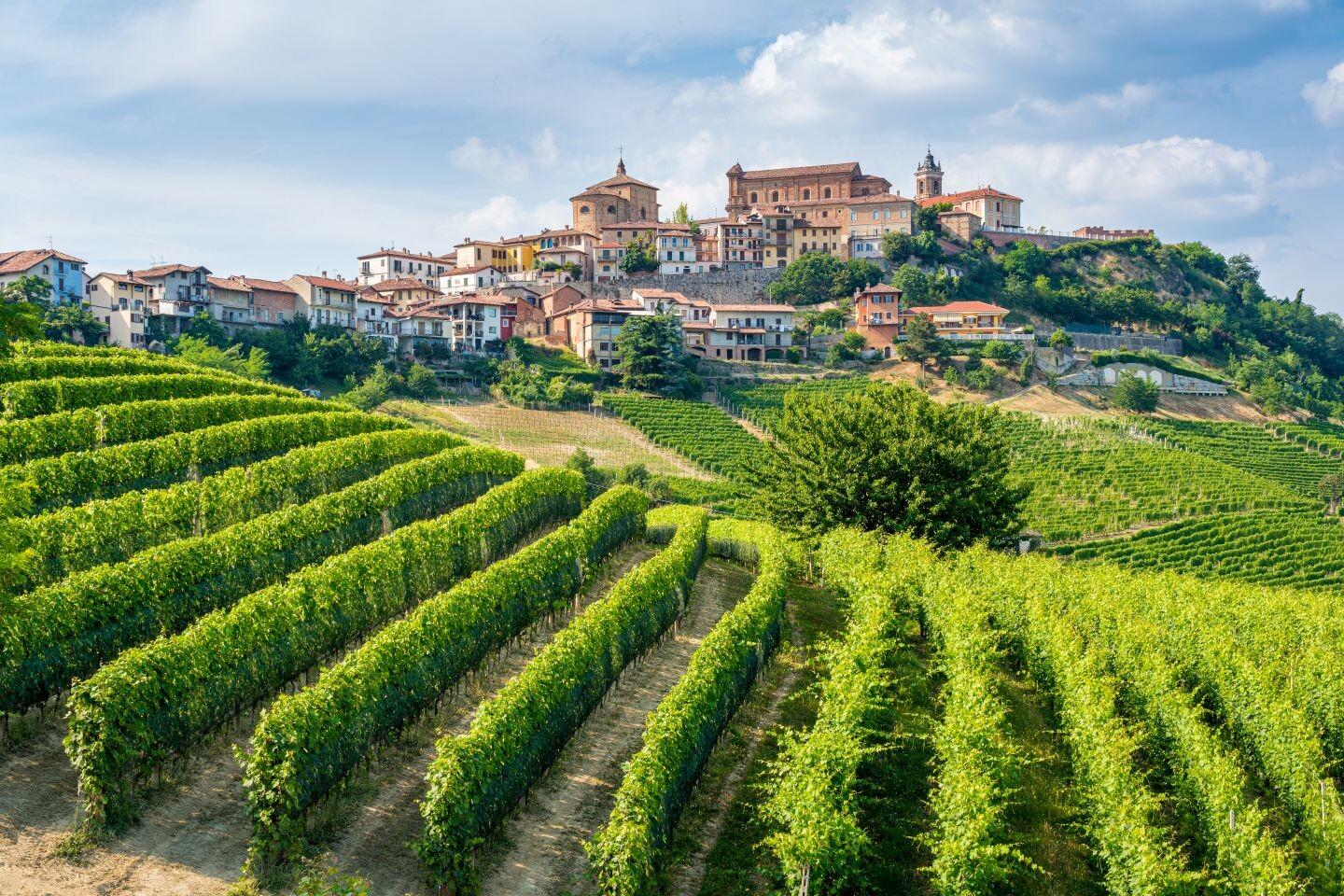
The rolling vineyard hills of Piemonte, where wine and local food have evolved alongside one another for generations.
One of the pleasures of Italian wine is how often the wine and the food appear to speak the same language.
Piemonte gives us butter, eggs, meat, hazelnuts, mushrooms, truffles, filled pasta and cheeses. Its wines respond accordingly. Acidity clears the palate. Tannin finds protein. Savoury flavours echo savoury food. Perfume provides lift against dishes that might otherwise feel rich.
This is why the idea of the “table wine” deserves more respect than it sometimes receives. A wine made to accompany dinner is not an unambitious wine. Making something delicious, distinctive and sufficiently balanced that people want to drink it while eating is its own kind of sophistication.
Italian producers have understood this for a very long time.
The bottles that tell you how a region lives
There is enormous pleasure in opening great Barolo: the anticipation, the history, the perfume, the slow unfolding of a wine that can seem to change every few minutes in the glass.
We would never suggest looking beyond Barolo by looking past it. Instead, look around it.
Drink the Barbera. Try the Dolcetto. Become acquainted with Grignolino and Freisa. Open a Langhe Nebbiolo without wondering whether you should have waited another decade. Put a bottle of Arneis beside lunch.
Because these wines reveal something that prestige alone cannot. They show us how Piemonte eats, how it drinks, and how wine becomes woven into everyday life rather than reserved for its most important moments.
The great bottles tell us what a region can achieve. The bottles on the table tell us who it is.
And in Piemonte, both stories are worth drinking.
Explore our Italian wines at Bricchi & Barrett.