
Nebbiolo Before Barolo: Discovering Piedmont’s Most Captivating Grape
There are some wines we learn by place before we learn them by grape. Barolo is one of them.
The name carries a certain weight. Cellars, vintages, celebrated vineyards, bottles opened after years of waiting. It has become one of the great reference points of Italian wine.
But behind Barolo is a grape: Nebbiolo.
And before thinking about the famous villages, crus and bottles destined for decades in the cellar, it is worth getting to know the variety itself. Because Nebbiolo is one of the reasons Piedmont is so endlessly fascinating.
A wine that rarely looks as powerful as it is
One of the first surprises with Nebbiolo is its appearance. It can be remarkably pale. In a world where we often associate deep colour with serious red wine, Nebbiolo does almost the opposite. The colour can be translucent ruby, moving towards garnet remarkably quickly.
Then you smell it: rose, violet, red cherry, raspberry, wild strawberry. Perhaps orange peel, dried herbs, spice or something slightly earthy underneath.
And then you taste it. This delicate-looking wine suddenly reveals acidity, structure and tannin.
That contrast is at the heart of Nebbiolo. It can be floral without being fragile, powerful without being heavy, structured without losing perfume. Few red grapes manage all of those things at once.

Piedmont begins to make sense through Nebbiolo
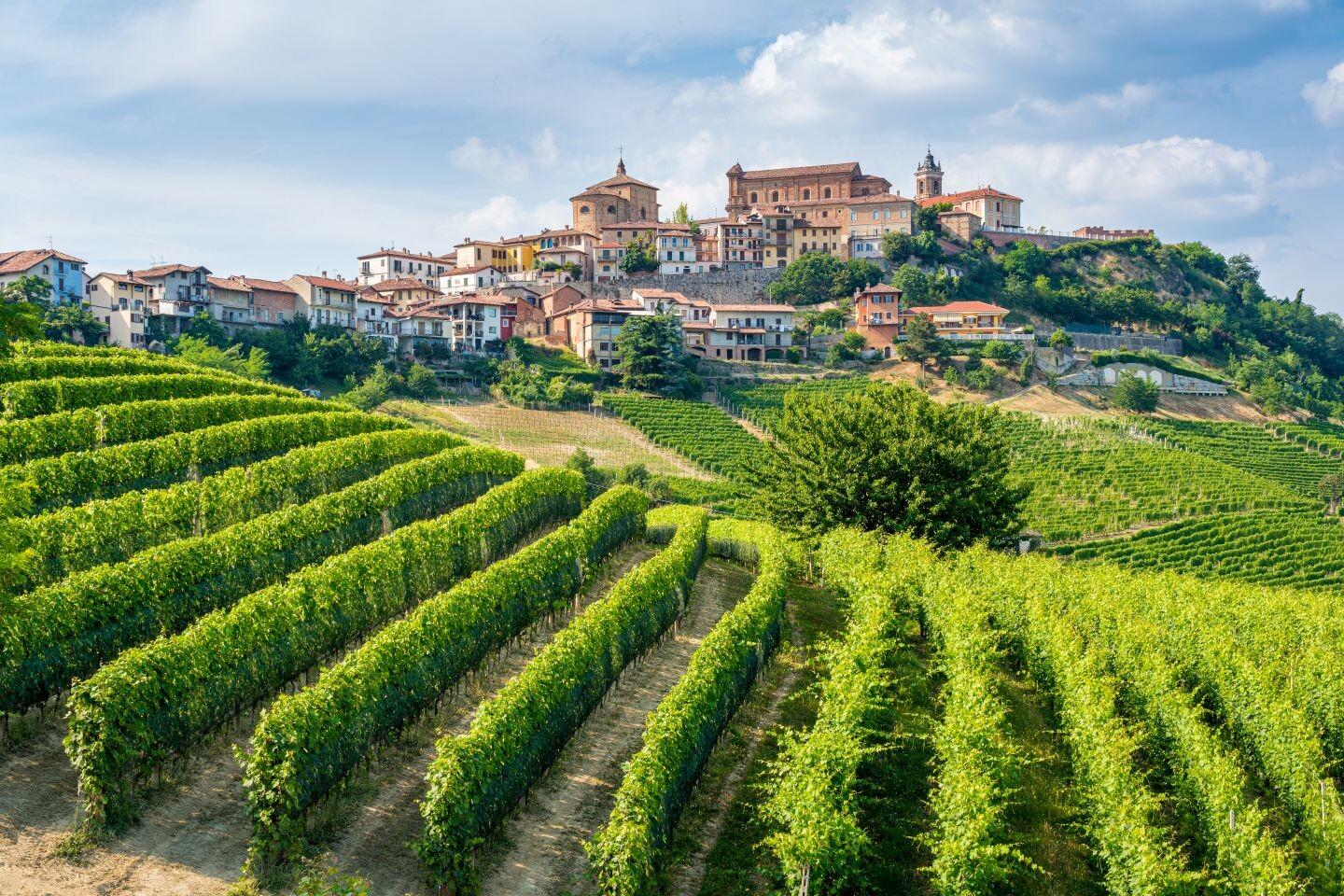
Nebbiolo is closely associated with the hills of Piedmont, particularly the Langhe. This is a landscape where relatively small changes in altitude, exposure and soil can make an extraordinary difference to the wine in the glass.
It is also why the conversation around Nebbiolo eventually becomes a conversation about place: Barolo, Barbaresco, La Morra, Neive, Serralunga d'Alba, Monforte d'Alba.
The names begin to matter because Nebbiolo has an unusual ability to reveal where it has been grown. But you do not need to begin with a great Barolo to understand that. In fact, sometimes it is easier not to.
Langhe Nebbiolo is often the perfect introduction
There is a tendency in wine to begin at the top. If Burgundy interests us, we immediately look towards the famous villages. If we want to understand Nebbiolo, we assume we should buy Barolo.
But there is something to be said for meeting a grape before meeting its most serious expression.
Langhe Nebbiolo gives us that opportunity. The wines are generally intended to be enjoyed earlier, allowing the fruit and perfume of Nebbiolo to show themselves without requiring the patience we often associate with Barolo.
You still find the things that make the grape distinctive: roses, red fruit, acidity and fine, persistent tannin. But everything can feel a little more immediate, a little less ceremonial. And sometimes that is exactly what we want from a bottle of wine.
The 2024 Fontanabianca Langhe Nebbiolo is a particularly good example. Fontanabianca is based in Neive, in the territory of Barbaresco, and its Langhe Nebbiolo gives a beautifully clear introduction to the variety: violet, red cherry, raspberry and wild strawberry, carried by freshness and fine tannin.
It is Nebbiolo without the need to make an occasion of it.

One grape, several personalities
This is where exploring Nebbiolo becomes particularly enjoyable. Not every bottle needs to taste the same.
The 2023 Boggero ‘Magis’ Nebbiolo, for example, shows another side of the grape, with bright red cherry and violet alongside freshness and chalky tannin.
Then there is the 2023 Hilberg Pasquero ‘29.5 Nebiø’ Nebbiolo, from the hills around Priocca. It is a particularly elegant interpretation: transparent, fragrant and finely structured, with rose, raspberry, cherry and wild herbs.
And then there is Elio Altare’s 2024 Langhe Nebbiolo.
Altare is one of the defining names of modern Piedmont, a producer who helped change the conversation around Barolo from his estate in La Morra. His Langhe Nebbiolo offers the same precision in a more immediate form. Fruit from La Morra and Monforte gives a wine lifted by rose petal, red cherry, raspberry and spice, with fine tannin and the energy that makes Nebbiolo so compelling.
It is perhaps one of the clearest examples of the idea behind this article: you can encounter the character of a great Nebbiolo producer before moving into the more serious territory of Barolo.
Same grape. Different places, different hands, different wines. That is precisely what makes Nebbiolo worth exploring.
And then, eventually, Barolo
Of course Barolo remains part of the story. It would be impossible for it not to.
Barolo is Nebbiolo shaped by place, time and tradition. And once you understand the grape — its perfume, its acidity, its tannin, its strange combination of delicacy and strength — Barolo itself begins to make more sense.
You start to recognise what comes from Nebbiolo. Then you can begin asking what comes from the vineyard, the village, the vintage and the person making the wine.
This is when the language of Barolo becomes less intimidating and considerably more interesting.
Nebbiolo belongs at the table too
For all the seriousness surrounding great Nebbiolo, it is worth remembering that these are wines from a deeply food-oriented culture. Younger Nebbiolo can be wonderfully useful at dinner.
Mushrooms make obvious sense. So does risotto. Roast poultry, veal, beef, pork, ragù, aged cheeses and dishes scented with herbs all have something to say to the grape.
Its acidity keeps richer dishes moving, its tannin gives it enough structure for meat, and its perfume brings something more interesting to the table than simple weight.
This is perhaps where Langhe Nebbiolo is at its most convincing. Not in a tasting room. Not beside a score. At dinner.
Before the famous name
Wine has a habit of directing us towards the important bottle: the classified vineyard, the famous appellation, the wine we are told we should cellar.
But sometimes there is more pleasure in beginning one step earlier.
Nebbiolo before Barolo. The grape before the hierarchy. A bottle opened on a Tuesday rather than saved for an anniversary.
Because once you begin recognising that pale colour, the roses, the red cherry and that unmistakable line of tannin, something interesting happens.
You stop thinking of Nebbiolo simply as the grape that makes Barolo.
And start understanding why Barolo could only really be made from Nebbiolo.
Explore Nebbiolo and the wines of Piedmont at Bricchi & Barrett.


